

The Hidden Cost of Brand Loyalty in Crop Protection
In consumer markets, economic research reveals a dynamic that farmers can learn from: the more expertise a buyer has in a product’s underlying chemistry, the less likely they are to pay for the brand name on the label.
Economists studying purchasing habits found that pharmacists buy generic headache remedies 91% of the time, compared to the general public who routinely pay up for legacy brands. Professional chefs do the same with pantry staples like salt and sugar. In both cases, the experts know that identical active ingredients deliver identical results. The premium survives solely because of the gap between what the marketer sells and what the user understands.
Farming is approaching that exact inflection point.
For decades, using familiar products and established brands has felt safe. The recognizable jug, the proven track record, and the reassurance of a multi-billion-dollar manufacturer provide psychological comfort. But that comfort carries a structural cost that most farming operations and ag retailers rarely quantify.
An off-patent, branded crop protection product’s price tag is actually not high because of the molecule itself. It is paying for a stack of legacy overhead bundled with the molecule including:
- Marketing & channel programs: Substantial budgets dedicated to brand building, defensive positioning, and complex rebate structures designed to lock in loyalty.
- Distribution & corporate overhead: The layered margins, sales organizations, and global corporate infrastructure required to support broad, legacy portfolios.
- Diminishing R&D returns: While discovery research has historically justified high margins, traditional discovery pipelines are increasingly struggling to deliver true novelty and step-change efficacy to the market.
The result is a substantial price premium that often has little to do with the intrinsic agronomic performance, or cost to manufacture the active ingredient.
When the active ingredient, formulation quality, and field-level efficacy are equivalent, paying a brand-name premium is simply funding someone else's marketing budget. As margins tighten and input decisions become more analytical, growers can gain a distinct edge by taking a page from the pharmacist’s playbook: look past the label, consider the chemistry, and capture the margin that brand loyalty has been leaving on the table.
The industry has seen a slowdown in novel synthetic molecules reaching the market over the past decade-plus.
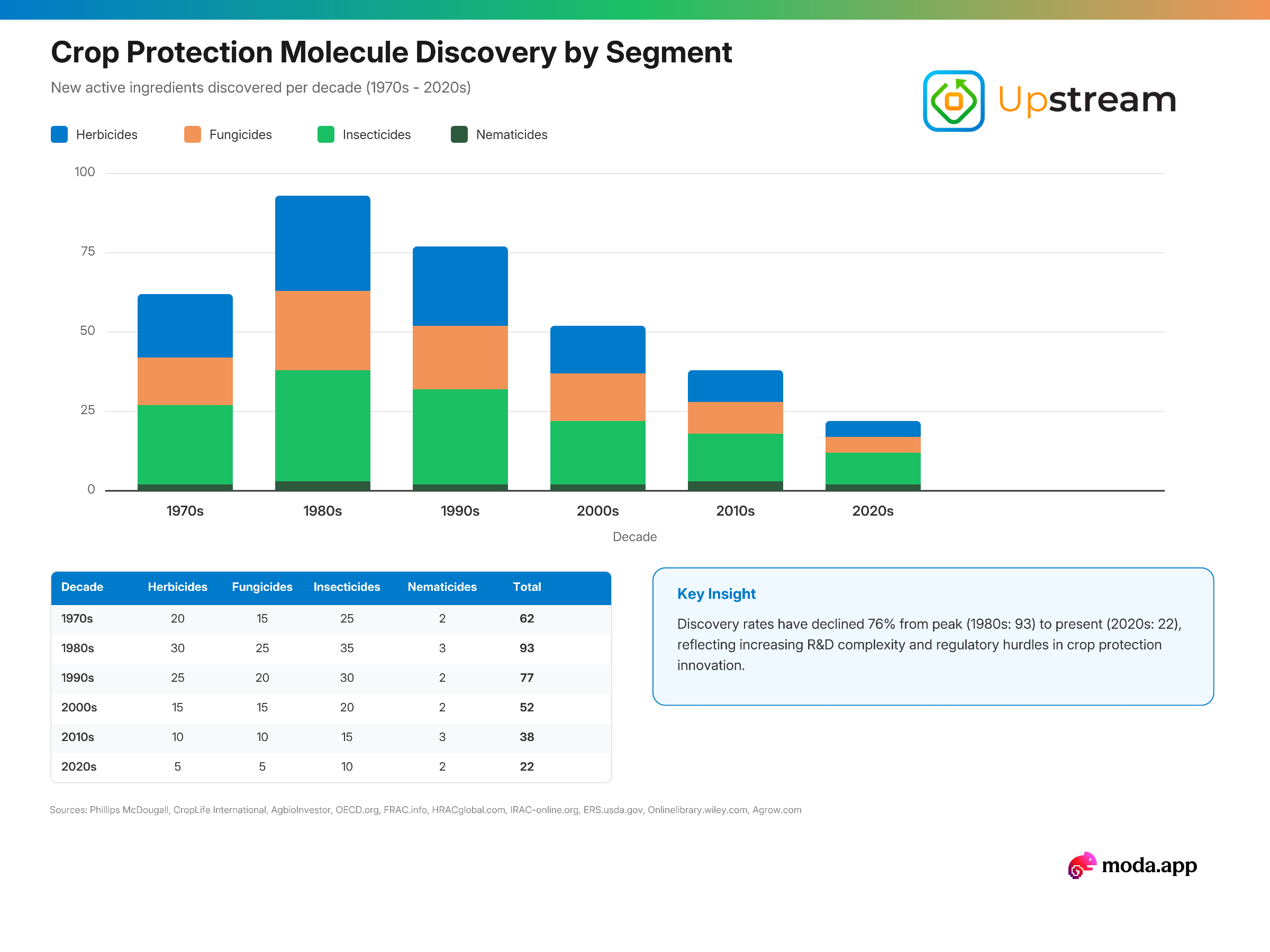
Source: Upstream Ag Insights
(Graphic credit: Upstream Ag Insights)
While companies continue to launch new formulations and combinations, truly new modes of action remain scarce. The majority of the highest-volume active ingredients are already off-patent or rapidly approaching that status. Future launches will still come, but the volume and frequency of game-changing chemistry is not what it was in earlier decades.
This is where disciplined cost management delivers both equivalent (or better) protection and superior profitability. When the same active ingredient is available as a certified premium generic at a meaningfully lower price, the economics open options that previously did not pencil. Applications that once felt marginal begin to make sense.
Example
Let’s consider pyraclostrobin (Headline). The active ingredient carries physiological effects beyond disease control like improved stress tolerance, better nitrogen utilization, and greater resilience under heat and drought. At branded pricing, using it at herbicide timing in cereals or pulses to manage lower disease levels often made little sense. However, at generic pricing, the same molecule can be deployed within the same herbicide pass to benefit from disease mitigation, plus those plant-resilience benefits. The disease control remains strong and the physiological upside becomes accessible. The net results are actually improved crop protection outcomes at a lower total cost, with the flexibility to treat more acres or add strategic timings that previously sat outside the budget.
Generic pricing changes the arithmetic. At the 0.16 L/ac rate used in cereals we can see a savings of ~$5/ac using the DYM Cypress 250 EC compared to traditional branded pricing, meaning you get the same active, same formulation, but a lower cost compared to branded and even a ~$2.51/ac below the best public generic price.
On 2,000 acres, that $5 turns into around $10,000.
Quality Still Remains
This is not a call to abandon performance and quality standards. Formulation quality, consistency, and support still matter. It is a call to separate the molecule’s actual value from the accumulated costs of brand, channel, and marketing overhead. In a market where new chemistry is slower to arrive, the operations that treat brand loyalty as an optional expense rather than a default will free up capital for the applications, timings, and system-level decisions that actually move the needle on yield and farm profitability.
The price difference is not just savings, but also optionality. And optionality, applied with agronomic rigor, is one of the highest-ROI tools available to a farm business today.